Science and Technology Museum LED display shaped creative customized design scheme strategy
Special-shaped creative customized design scheme and resolution selection strategy for LED indoor display screens in science and technology museums
In the field of digital exhibitions, science and technology museums, as the core carrier of scientific communication and immersive experience, have put forward higher requirements for the form innovation and display performance of LED display screens. According to statistics, in 2023, 67% of interactive devices in global science and technology exhibition halls use special-shaped LED display screens, but the resolution matching error rate is as high as 42%, resulting in a significant deviation between the visual experience and design expectations. This article will systematically analyze the creative realization and parameter optimization scheme of LED screens in science and technology museums from two dimensions: special-shaped screen customization design logic and scientific resolution adaptation method.
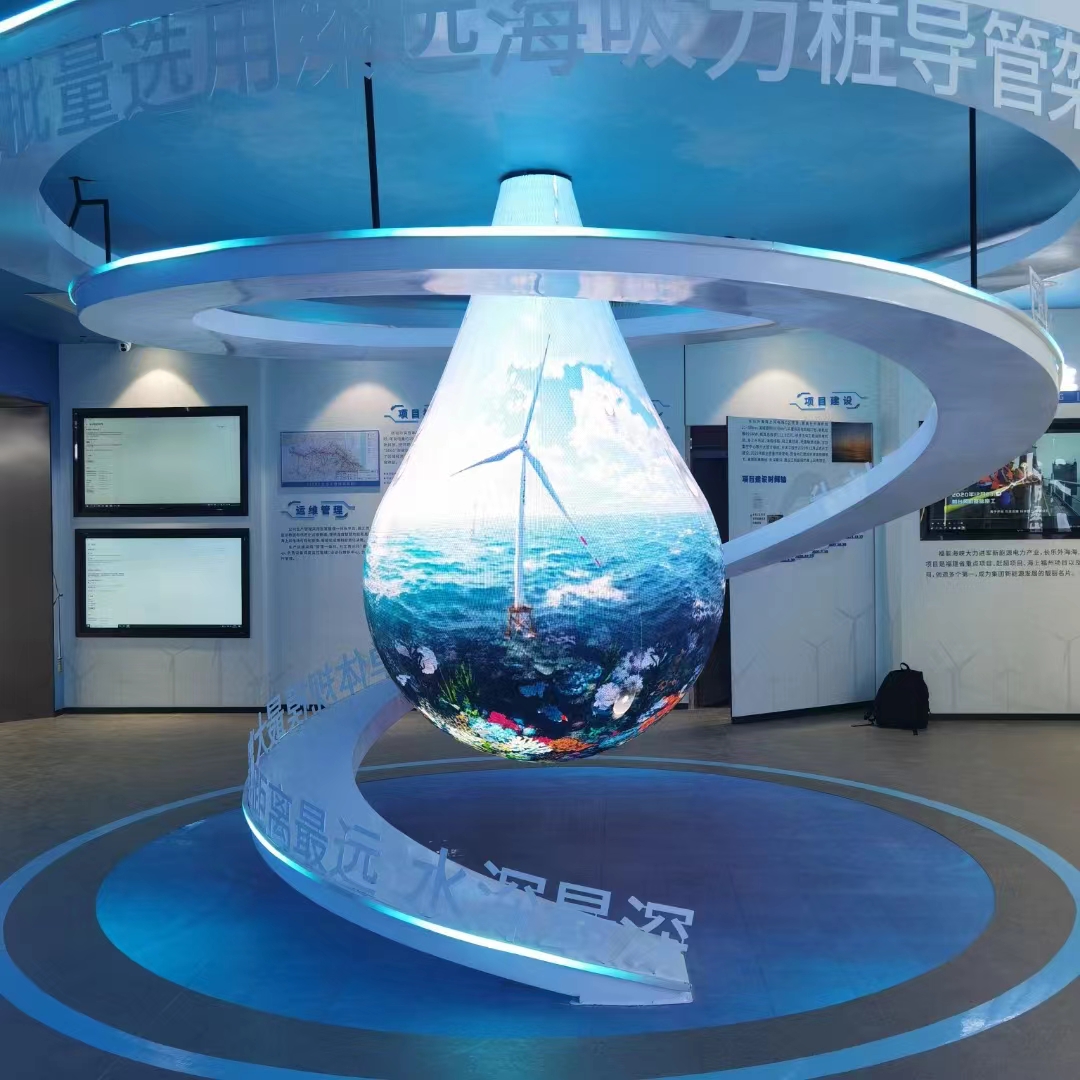
1. Creative design methodology for special-shaped LED screens
1. Morphological design driven by spatial narrative
Special-shaped screens need to be deeply coupled with the theme of the exhibition hall. Common design patterns include:
Bionic structure: DNA double helix (pixel density ≥ 6 points/cm²), celestial curved surface (curvature radius R ≤ 3m)
Geometric deconstruction: parametric diamond splicing (module angle 15°~75°), infinite mirror reflection array
Interactive carrier: touch wave screen (pressure sensing accuracy ≤ 0.1N), holographic suspended pixel column
Case: The "Galaxy Curtain Wall" of the Shanghai Planetarium uses a 270° ring screen with a radius of 8 meters. Through the splicing of 1682 P1.8 arc modules, 288,900 pixels per square meter of starry sky particle rendering is achieved.
2. Core technical specifications of special-shaped screens
Parameter category Design standard Typical value example
Minimum bending radius ≤1/3 of the long side of the module 500mm long module bending ≥170mm
Jointing tolerance Flat screen ≤0.5mm, curved screen ≤1.2mm Total joint of spherical screen ≤3‰ diameter
Signal synchronization error Frame delay ≤1ms, color difference ΔE<1.5 3840Hz refresh rate +16bit color depth
3. Interdisciplinary collaborative design process
Architectural pre-embedded analysis: load-bearing nodes (load ≤120kg/m²) and cone coverage areas marked in the BIM model
Optical simulation: LightTools software is used to simulate the uniformity of light intensity distribution on different curved surfaces (target ≥85%)
Content rendering adaptation: UE5 engine is used to adjust the 3D model topology in real time to match the physical pixel arrangement
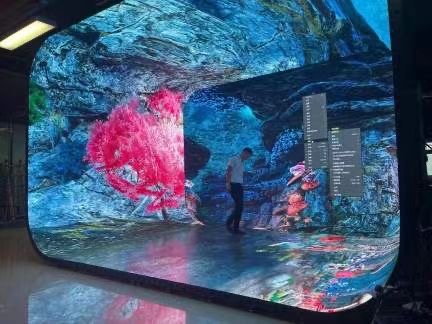
II. Four-dimensional decision model for resolution selection
1. Visual perception experience benchmark
Static display items: meet the minimum recognition angle of Snell's lawCopy
Minimum pixel height H = D × tan(θ)
(D=viewing distance, θ=human eye limit resolution angle 1.5')
Example: 2 meters distance requires H=2×tan(0.025°)=0.87mm → corresponding to P0.9 screen
Dynamic image: resolution ≥ 1.25 times of content source (8K video needs to match 9.6K physical resolution)
2. Spatial parameter weight analysis
Influence factor Calculation formula Correction coefficient
Viewing distance L Basic resolution ∝1/L² K1=0.8~1.2
Ambient illumination E Compensation resolution=E/150 lx K2=1+E/500
Viewing angle coverage α Effective resolution=nominal value×sin(α/2) α≥120° K3=1.3
Application example:
An immersive theater with a viewing distance of 5 meters, an illumination of 300lx, and a coverage angle of 150°:
Theoretical resolution reference value=P1.2, after correction:
P1.2 × (300/150) × 1.3 = P0.65 (Micro LED technology is required)
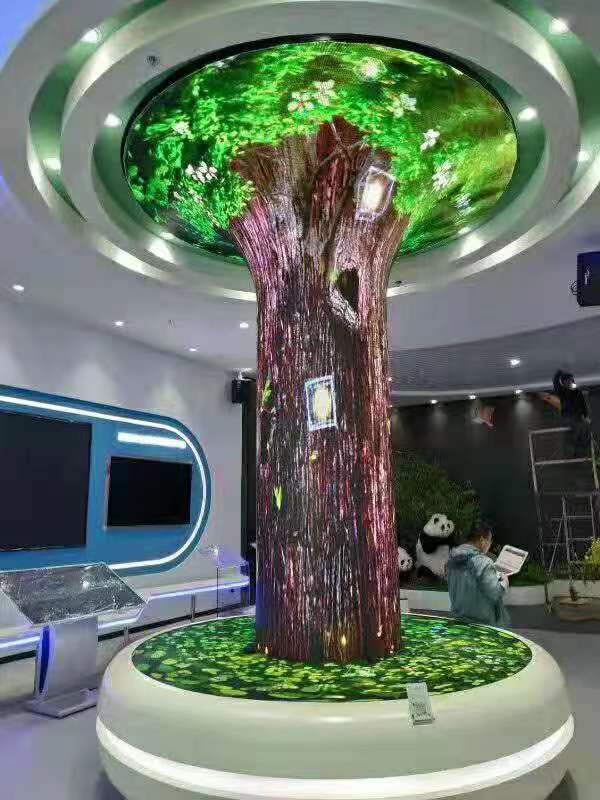
3. Content type adaptation table
Content format Resolution requirements Recommended technical solutions
Particle effects Pixel density ≥ 160,000 dots/m² COB package P0.6 screen
AR interactive interface Touch point accuracy ≤ 1.5mm Infrared frame + capacitive film composite solution
Stereoscopic holographic Vertical resolution ≥ horizontal value × 1.5 Columnar screen 3840 × 5760
Data visualization Character height ≥ 1/30 of screen height SMD P1.5 + graphic enhancement algorithm
4. Full life cycle cost optimization
Initial investment: Unit cost formula of special-shaped screen
Copy
Cost = A × (P⁻¹.3 + S^0.7)
(A=area coefficient, P=pixel pitch, S=curvature complexity)
Operation and maintenance cost: The failure rate of curved screen is 18% higher than that of flat screen, and 15% redundant pixels need to be reserved
Upgrade flexibility: Choose to support NVIDIA Omniverse's module can realize virtual pixel reconstruction
III. Typical scenario solution library
1. Immersive dome theater
Structure: 12-meter diameter geodesic sphere
Technical parameters:
Resolution: P1.2 screen, total pixel volume ≈ 120 million points
Synchronous control: 48-channel 4K@120Hz fiber signal ring network
Curvature compensation: Each module loads an independent Gamma correction table
2. Interactive mechanical matrix
Design: Programmable sculpture composed of 256 P2.5 cube modules
Key technologies:
Dynamic resolution switching: 4K when stationary/2K when dynamic to reduce latency
Six-axis servo positioning: Position repeatability ±0.05mm
Wireless power supply: Qi standard + 15cm mid-range coupling efficiency ≥82%
3. Transparent suspended corridor
Configuration: P3.9 transparent screen (transmittance 65%) + holographic film
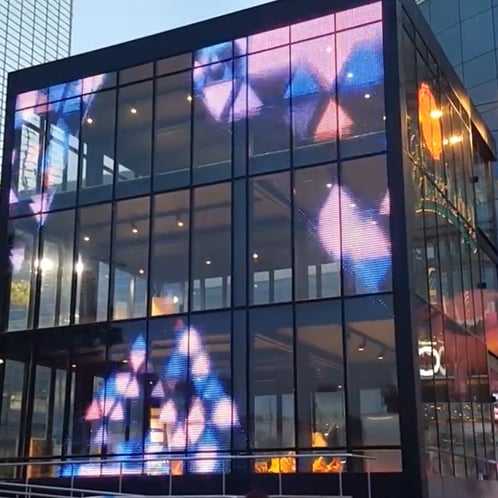
Innovation:
Resolution enhancement: Improve equivalent PPI through sub-pixel rendering technology 40%
Multi-layer superposition: 3 layers of display screens are offset by 0.3mm to achieve naked-eye 3D
IV. Future trends and suggestions
Technology evolution: In 2025, the cost of Micro LED special-shaped screens will drop to 58% of the current price, and experimental projects can be planned as a priority.
Design paradigm: It is recommended to adopt the "digital twin + real-time rendering" workflow to preview the physical resolution effect in the virtual space.
Standard construction: Refer to the "GB/T 40256-2021 Special-shaped LED Display Technical Specifications" to establish an acceptance index system.
Conclusion:
The design of LED special-shaped screens in science and technology museums needs to break through traditional display thinking. While pursuing visual shock, a mathematical resolution decision model should be established. Only by incorporating spatial topological data, human eye physiological characteristics, and content dynamics parameters into a unified algorithm framework can a perfect balance between artistic expression and scientific accuracy be achieved.
 English
 中文
中文